The (Controversial) Meaning of Open Source in Software
In its common meaning, the concept of open source is rooted in the software community by being derived from the notion of « source code ». « Open source » is related to the idea of a software with an available source code. However, the concept of open source is not defined solely by the availability of code, and it’s where we end up with different interpretations of what “open” might mean.
There is not just one but several open source communities that are divided over a war of words. With several contradictory meanings, where is the truth?
The Open Source Definition, the mainstream liberal view
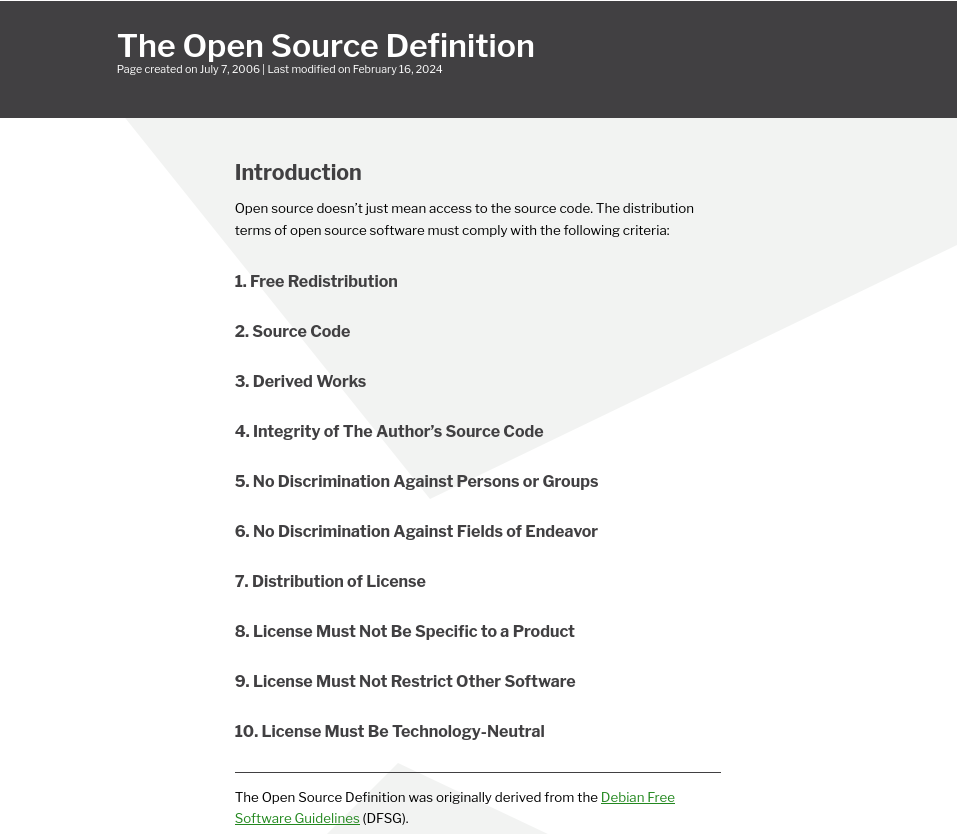
To understand the meaning of open source it’s essential to understand the « Open Source Definition » (OSD) of the Open Source Initiative (OSI) which codifies its classical and historical meaning: https://opensource.org/osd
Created in 1998 at the origins of the OSI, the OSD defines a set of criteria for the license of a software in order for it to be considered open source. A software that provides its source code which can be used, modified and shared, without restricting certain types of actors or usages.
If a software complies with these criteria, it’s considered as « open source ». On the contrary, if the license were to restrict any use or actors, then it would no longer be « open source ».
Since its inception, the Open Source Initiative has claimed to be the authority that defines open source. It is backed by a strong community support, which gives or denies meaning to this concept by relying on the OSD.
They tried to register « open source » as a trademark, which was denied to them. The meaning given to open source is becoming a matter of social pressure to preserve and enforce this meaning.
The OSD derived from the Debian Free Software Guidelines created in 1997, essentially a renaming of the document. What mainly defines « open source » in software comes from a document that was not created for this purpose before the concept was even (re)coined.
A solitary decision made by Bruce Perens and Eric Raymond.
The Open Source Dissensus
What happens when this Open Source Definition is not respected? When a software source code is available but when some actors will impose restrictions as it is common with various open (or not) licenses. Tensions arise from it over the meaning of this concept.
These restrictions will initially be motivated by economic or ethical considerations. A person or organization that wants to control how large technology companies use their products in order to limit what they consider to be plundering, or that wants to ensure that their solution is not used in security or military fields, for example.
We can mention the Business Source License which will impose restrictions on commercial use or the Hippocratic License which requires respect for human rights and ethical values of project holders.
The Organization for Ethical Source symbolizes this conflict within the community which stems from opposition to the views of the Open Source Initiative.
Call it something else! The terminological proliferation
Project holders with these restrictions will regularly talk about open source, sometimes by being completely unaware about the existence of this Open Source Definition.
Advocates of the Open Source Definition of the Open Source Initiative will reject the label of open source for these software. Rather than talking about open source software, they will try to impose to « call it something else ».
From this logic and from the dominant viewpoint, a variety of terms are emerging: source available, fair source, ethical source, fauxpen source, shared source, fair code, non-compete source…
The Open Source Initiative will completely reject these alternative visions of open source, going so far as to compare their definition to the kilogram.
Or call it open source, contestation of the Open Source Definition
« Ultimately, we are the heart and soul of FLOSS, not the Free Software Foundation or the Open Source Initiative or GitHub. We have the responsibility to put ethical principles over the philosophical purity of ‘software freedom’. »
Coraline Ada Ehmke, co-founder of the Organization for Ethical Source in the article From open source to ethical source

In the face of criticism coming from this mainstream view, some people will continue to talk about « open source » for their software without complying with this Open Source Definition. This represents another perspective on the practice of how to open the source code.
A couple of cases have already been referenced: https://codeberg.org/danb/Open-Source-Confusion-Cases
These people are under attack by part of the community but maintain a different approach to what « open source » could mean.
The definition of « open source » is a source of political and ideological conflicts which makes it difficult to understand the exact meaning of this concept.
Words are sometimes difficult to define, and “open source” is one of them.
« Not doubt, certainty is what drives one insane. », Friedrich Nietzsche