Open Source 2.0: The Open Source Resources Paradigm
This is one of the first attempts ever to explain « open source » under the paradigm of open source resources. Open source becomes no longer a concept derived from the idea of source code but mostly from source files and to some extent also source of information (as from OSINT [Open Source Intelligence]).
A multitude of digital resources operate in a final format that can be used by the end user alongside an editable format that is often more heavy to modify this resource, uncompressed format vs. compressed format.
This page seeks to demonstrate the relevance of access to sources for different types of digital resources, and sometimes the already existing usage of the concept of open source outside of software based on these challenges.
A shift from an open source software to open source resources mindset may be critical to foster collaboration around digital resources in other openness movements (open science, open education, open hardware, open data…).
Basic example of open source resource: A pdf document under an open license shared with its odt/docx/latex source file.
The An Open Source Definition
1. Practice of releasing publicly a digital resource with its source files (ex: open source resource, open source educational resource, open source software, open source image…).
2. (From OSINT) Information or resource based on publicly available source (ex: open source dataset).
Open Source Educational Resources
With open education, resources are commonly called « Open Educational Resources » (OER). Alternatively, the notion of « Open Source Educational Resources » has been suggested to specify OERs that would provide their source files.
What do you mean by “open-source educational materials”?
“Open-source” implies that there are source files that are converted and rendered into a final learner-presentable form. Examples include Jupyter notebooks or plaintext/markup language documents like LaTeX, Markdown, ReStructuredText, AsciiDoc, and R Markdown.
About section of the Journal of Open Source Education
Examples of Open Source Educational Resources: This knowledge base as the website’s markdown files are provided on Codeberg. Similarly, The Turing Way handbook (see debate around the question “Is the Turing Way Open Source ?”).
Open Source Article
In open science, it’s common to speak of open access articles to consider access to articles for documents generally in pdf format. An open source article will be about providing all the underlaying material used to produce the pdf (latex, markdown, docx, odt files…), taking also into account other elements such as figures (see open source images).
Example: For any article on arXiv you can download both a pdf and its « tex source » such as with the article mentioned above entitled « Developing Open Source Educational Resources for Machine Learning and Data Science ».
Open Source Image
If you provide the source for the image so that I can modify it and it uses an OSI compliant license, then yes, I would say it’s an open source image.
What constitutes Open Source or not is very clear now for software, but for other artifacts, that might not be so clear.
A member of the Open Source Initiative in a private email.
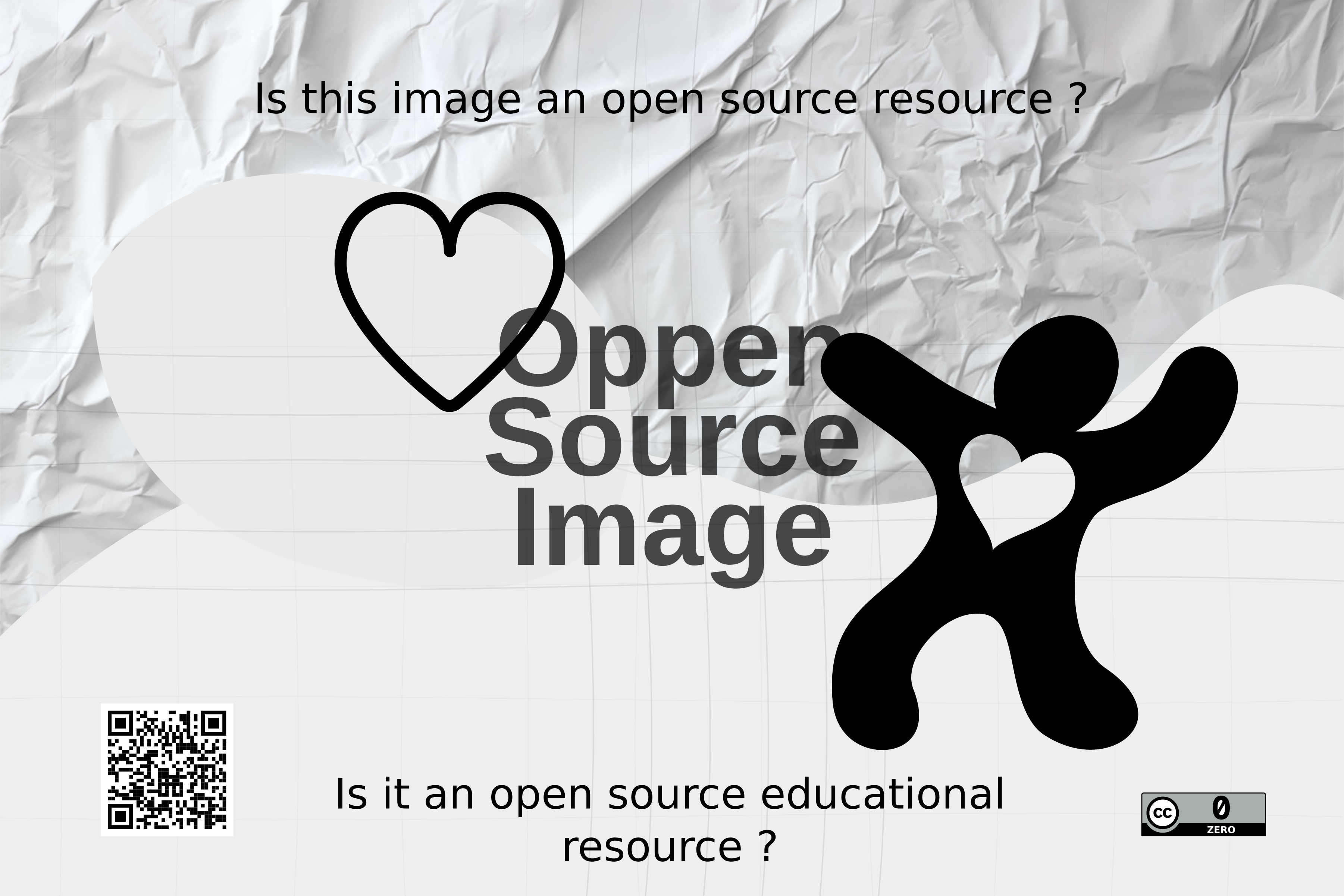
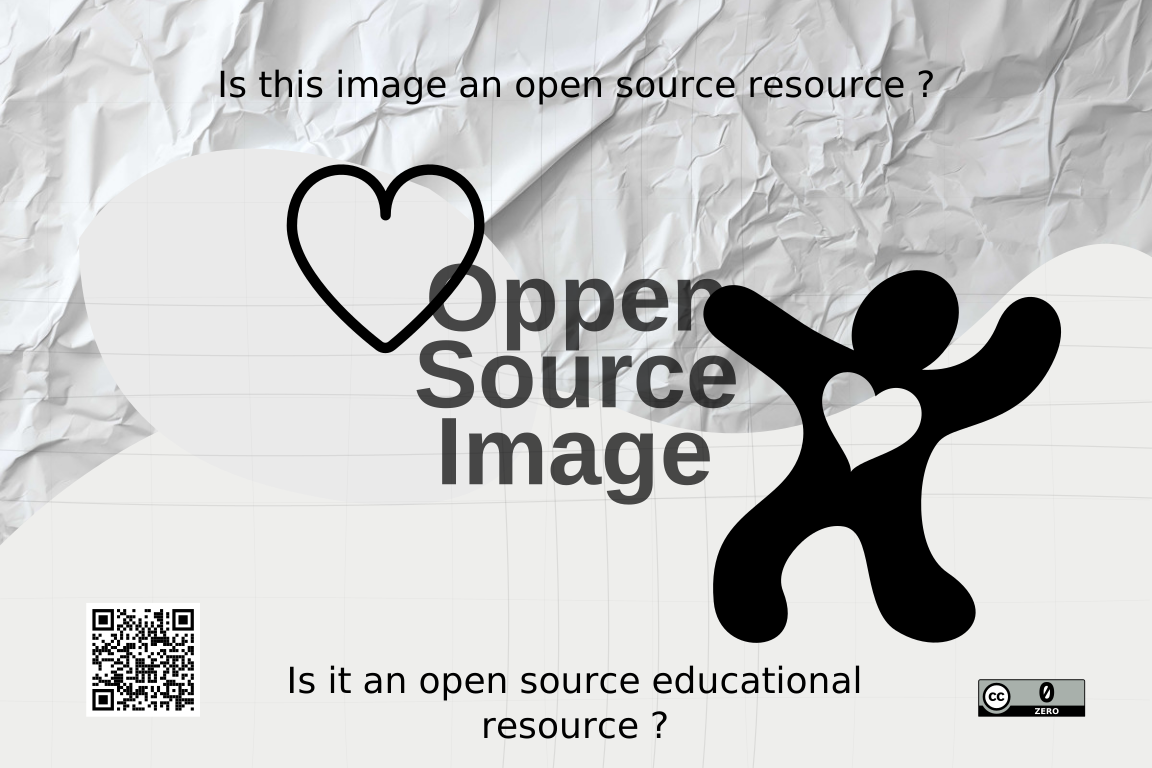
Images and designs can be formed with a set of layers. The image formats usually used are compressed (e.g.: png/jpeg), aggregating these layers, but access to these original, decompressed source files will enable the images to be modified.
Examples of open source images: Photoshop uses psd files before exporting to jpeg/png/etc. The spelling mistake of the following image under CC0 will be hard to edit on the png format while the text can be easily modified using the svg format (with a tool like Inkscape).
Open Source Hardware
[Expand around blueprint in 3D pdf vs ifc/rvt]
Open Source Data
[Expand around dataset vs source of the dataset]
Open Source Music
[Expand around mp3 vs MIDI files]
Open Source Video
[Expand around MP4/AVI/… vs tools files (.kdenlive, .osp, .mlt, .blend)]